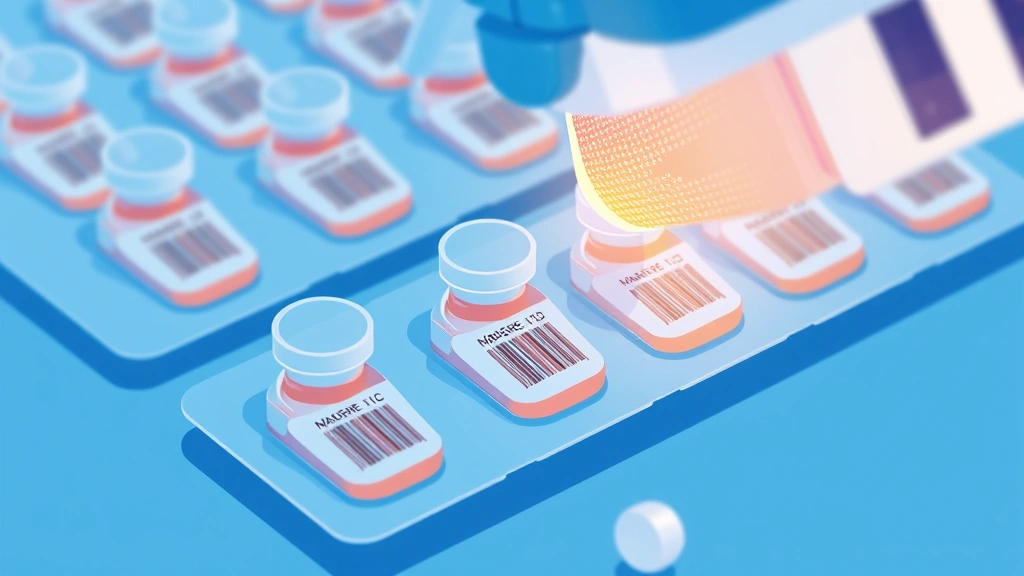
Europe’s pharmaceutical industry and its hospital pharmacists have jointly proposed putting a barcode on every individual dose of medicine — each vial, pre-filled syringe and pen — rather than only on the outer pack. Under guidance published on September 7, 2026 by the European Federation of Pharmaceutical Industries and Associations (EFPIA) and the European Association of Hospital Pharmacists (EAHP), all new products would carry dose-level codes from 2031, with existing medicines retrofitted gradually.
“Over the next five years, all new medicines will include a barcode on every dose,” said EFPIA Director General Nathalie Moll.
What already exists, and why it is not enough
Barcoding is not new to European medicines. Since 2019, prescription and certain over-the-counter products have been required to carry a machine-readable unique identifier on the pack, alongside tamper-evident packaging.
That system was built for a specific purpose: keeping falsified medicines out of the legitimate supply chain. Each pack’s identifier is checked against a central repository and decommissioned when dispensed, so a counterfeit or a duplicated code is caught. It is a supply-chain security mechanism, and it works at the level of the box.
The box, however, is not where most medication harm happens. A verified pack tells you the product entering the pharmacy is authentic. It tells you nothing about whether the vial a nurse draws up at 3 a.m. is the right drug, the right strength, for the right patient. Once the outer packaging is opened and individual units are separated, the traceability chain simply ends.
The safety case
Extending codes to the unit of use enables bedside scanning — scanning the dose and the patient’s wristband at the moment of administration and having the system confirm the match against the prescription. This is the last checkpoint in what hospital pharmacists call closed-loop medication administration.
The evidence cited is substantial. Studies of bedside scanning report medication error reductions of 30–60%, and research specific to individual-dose barcodes points to roughly a 41% reduction in error rates. The guidance also frames dose-level identification as a prerequisite for meaningful electronic patient record integration, better use of healthcare resources, and hospital efficiency gains — administration records that populate themselves rather than being transcribed.
Dose-level identification also improves what happens when something goes wrong. Recalls currently operate at batch and pack level; codes on individual units make it possible to determine precisely which doses reached which patients.
Why it is harder than it sounds
Two obstacles are named directly in the guidance, and both are real.
The first is physical space. Pack dimension constraints are manageable on a carton; they are severe on a 2 ml ampoule or a small vial where the label already carries the drug name, strength, batch number, expiry and warnings. Fitting an additional reliably scannable code onto curved glass, in a size a ward scanner can read, is a genuine packaging-engineering problem.
The second is manufacturer investment. Dose-level serialization means new printing and vision-inspection equipment on packaging lines, revalidation, and data systems capable of handling orders of magnitude more identifiers than pack-level codes generate. That cost falls on manufacturers, which is notable given that EFPIA — representing those manufacturers — is co-authoring the proposal rather than resisting it.
A third obstacle sits outside the guidance’s control: the codes deliver nothing unless hospitals can scan them. Bedside scanning requires devices at the point of care, electronic prescribing, and integrated records. Adoption of that infrastructure across European health systems is highly uneven, and a barcode nobody scans is just ink.
The United States did this in 2004
Worth noting for perspective: the idea is not new, and Europe is not leading it.
The FDA issued a bar code label requirement in 2004, effective from 2006, mandating machine-readable National Drug Code information on most prescription drugs used in hospital settings — explicitly including unit-dose packages. The stated purpose was the one EFPIA and EAHP are advancing now: enabling scanning at the point of administration to confirm the right drug reaches the right patient.
Two decades of American experience since then offers a useful caution. The barcode mandate alone did not eliminate medication errors. Benefits materialized only where hospitals invested in the surrounding system — scanners at the bedside, electronic prescribing, integrated administration records, and workflows that did not tempt staff into scanning shortcuts under time pressure. Where that investment was absent, the codes went unread. Europe’s 2031 proposal inherits both the promise and that lesson.
What to watch
The 2031 date gives manufacturers roughly five years to design dose-level coding into new products, which is a realistic runway for packaging changes but tight for retrofitting legacy portfolios — hence the phased approach for existing medicines.
The most consequential question is whether this stays voluntary industry guidance or becomes a regulatory requirement. Joint EFPIA/EAHP guidance signals alignment between the people who make medicines and the people who administer them, which is often how European pharmaceutical rules begin. It is not, by itself, law. Regulatory news; timelines and requirements may change.